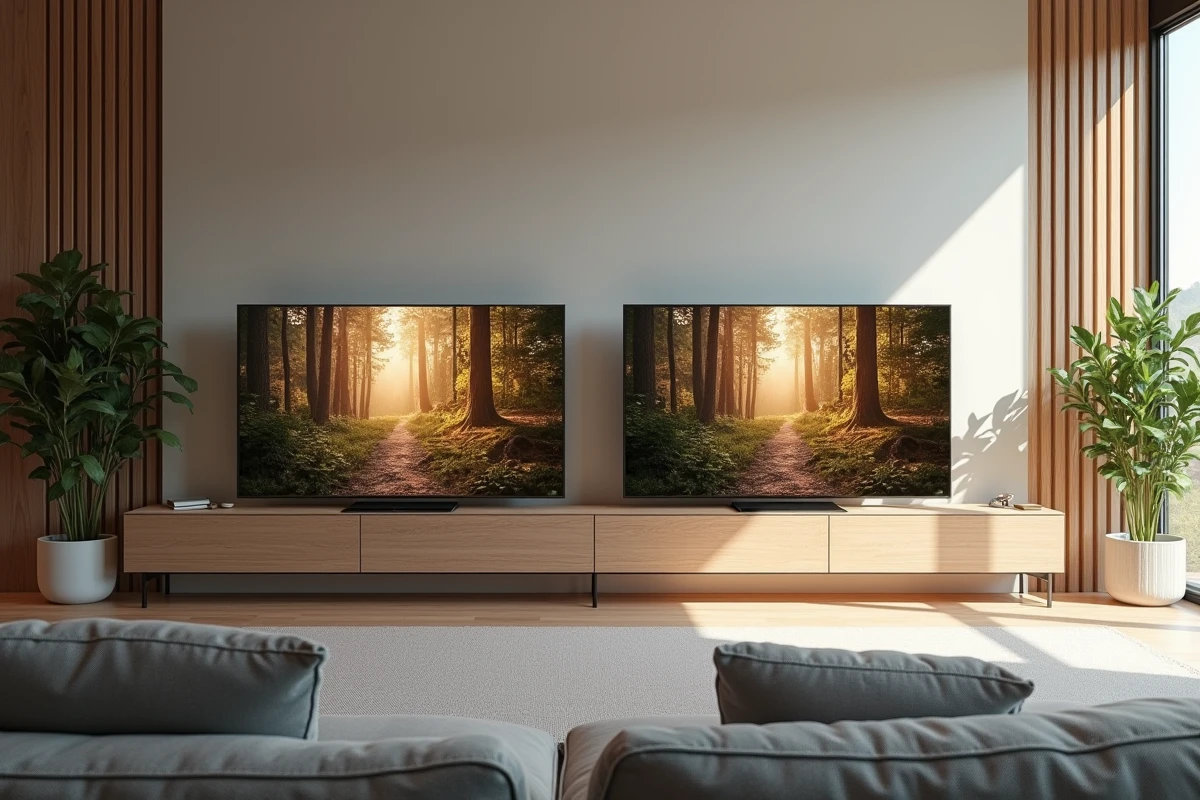
Are you looking for a new television and come across two similar acronyms: ULED and QLED? Behind these closely named technologies lie different technical approaches, driven by distinct brands. Understanding what separates them can help avoid a disappointing purchase, especially when the budget exceeds several hundred euros.
Backlighting and quantum dots: what happens behind the panel
Both ULED and QLED rely on LCD panels. The light does not come from the pixels themselves (as with an OLED), but from a LED panel placed at the back of the screen. The difference lies in how each brand optimizes this common foundation.
QLED refers to a technology developed by Samsung (and adopted by TCL). It adds a layer of nanocrystals, called quantum dots, between the backlighting and the panel. These crystals convert blue light into purer colors, which expands the visible palette on the screen. The result: more saturated reds, greens, and blues, often with high brightness.
ULED is a term specific to Hisense. It does not refer to a single component but to a set of software and hardware optimizations applied to an LCD screen. Image processing, local dimming management, color calibration: everything is grouped under this label.
On recent models branded ULED X, Hisense integrates mini-LED backlighting with thousands of local dimming zones, bringing these televisions closer to the contrast level of high-end QLEDs. To delve deeper into this ULED vs QLED comparison, one must look beyond the marketing labels.

Supported HDR formats: a concrete advantage for Hisense ULED
Do you watch movies on Netflix or Disney+ in HDR? The format used matters more than you might think. And in this regard, recent ULEDs have a real advantage over Samsung QLEDs.
Since 2023, most ULED televisions sold in Europe (U7KQ, U8KQ ranges) support Dolby Vision, HDR10+, and sometimes IMAX Enhanced simultaneously. This broad compatibility means that the television can utilize the dynamic metadata from each source, frame by frame.
Samsung QLEDs, including models like the Q80C or QN90C, do not offer Dolby Vision. Samsung relies on HDR10+ and standard HDR10. For content encoded in Dolby Vision (a large part of the Netflix catalog and UHD Blu-rays), the Samsung television does not take advantage of all the available information.
In practice, this results in poorly managed dark scenes or less accurate highlights on a QLED compared to a ULED playing the same content in Dolby Vision. This is not a flaw of the panel; it is a choice of software compatibility.
Everyday image quality: brightness, contrast, and colors
Outside of HDR, how do these two technologies perform for everyday use?
Brightness and bright rooms
Samsung QLEDs generally display high peak brightness. In a living room with large windows, the image remains readable even in broad daylight. Hisense’s ULED X, thanks to mini-LED, reaches comparable levels on recent models.
On entry-level ULEDs (without mini-LED), brightness remains acceptable but significantly lower than that of a mid-range or high-end QLED.
Contrast and blacks
Contrast directly depends on the number of local dimming zones. A ULED X with thousands of zones competes with a mini-LED QLED. A standard ULED, with fewer zones, will display grayer blacks in a dark room.
QLEDs without mini-LED exhibit the same flaw. The quantum dot technology enhances colors, not the native contrast of the LCD panel.
Color fidelity
The quantum dots in QLEDs offer a wide color gamut right out of the box. ULEDs compensate with software processing that adjusts colorimetry based on the content. Both approaches yield good results, but a QLED often has a slight advantage in saturation for vibrant colors.
Choosing between ULED and QLED based on your actual usage
Rather than comparing technical specifications in detail, here are the criteria that tip the choice one way or the other:
- You watch a lot of HDR streaming content (Netflix, Disney+, Apple TV+): a recent Hisense ULED will give you access to Dolby Vision, which is absent from Samsung. This is a tangible advantage for movies and series.
- You play on console or PC in a very bright room: a Samsung QLED offers reliable peak brightness and well-optimized response times on gaming models. The Game mode of QLEDs remains a reference.
- You are looking for the best price-to-quality ratio on a large screen: Hisense positions its ULEDs, including ULED X, at generally lower prices than Samsung QLEDs for equivalent screen sizes.
- You are sensitive to deep blacks for cinema in a dark room: aim for a mini-LED model, whether ULED X or QLED, with a large number of dimming zones.
Why is this choice between ULED and QLED not as clear-cut as it seems? Because the range matters more than the displayed technology. A high-end ULED X will outperform an entry-level QLED, and vice versa.
The real trap would be to choose solely based on the acronym printed on the box. Check the type of backlighting (mini-LED or standard LED), the number of dimming zones, the supported HDR formats, and the size of the panel relative to your viewing distance. These four criteria determine image quality far more than the commercial name of the technology.