
A patient has just arrived on a care ward. The nurse opens their file and needs to assess their needs: nutrition, mobility, sleep, hygiene, as well as sexuality, attitudes toward death, and the expression of their beliefs. Nancy Roper’s model proposes structuring this assessment around twelve activities of daily living. The principle seems simple, but applying it raises a practical challenge: how can sensitive topics be addressed without reducing the person to a checklist?
Sensitive activities of living: sexuality, death, and patient consent
The Roper-Logan-Tierney model identifies twelve activities of living, some of which touch on deeply personal matters. Among them, “expressing sexuality” and “dying” are the most difficult to address in clinical practice.
A qualitative study of nursing students in Turkey (Turhal et al., BMC Nursing, 2026) described the discomfort, anxiety, and taboo-related barriers involved in collecting data on the activity “expressing sexuality.” Students reported a lack of knowledge and emotional barriers, even in simulated situations. A holistic framework alone does not make sensitive topics easy to discuss.
This finding has direct implications. Completing the Roper diagram does not mean mechanically asking about every activity at the first meeting. Gathering information about sexuality or spirituality requires a trusting relationship, appropriate timing, and, above all, the patient’s explicit consent. If the patient has not given consent, it is better to leave that section blank and return to it later.
A recent chapter on the model (Ozgur Press, 2026) also presents death and the end-of-life process not as a simple biological endpoint, but as a dimension encompassing physical, psychological, social, cultural, and spiritual needs. Assessing this activity of living requires preserving the person’s preferences and autonomy, even as their dependence increases.
To explore Nancy Roper’s theory in nursing further, it is therefore important to account for the tension between the model’s comprehensiveness and respect for each patient’s pace.
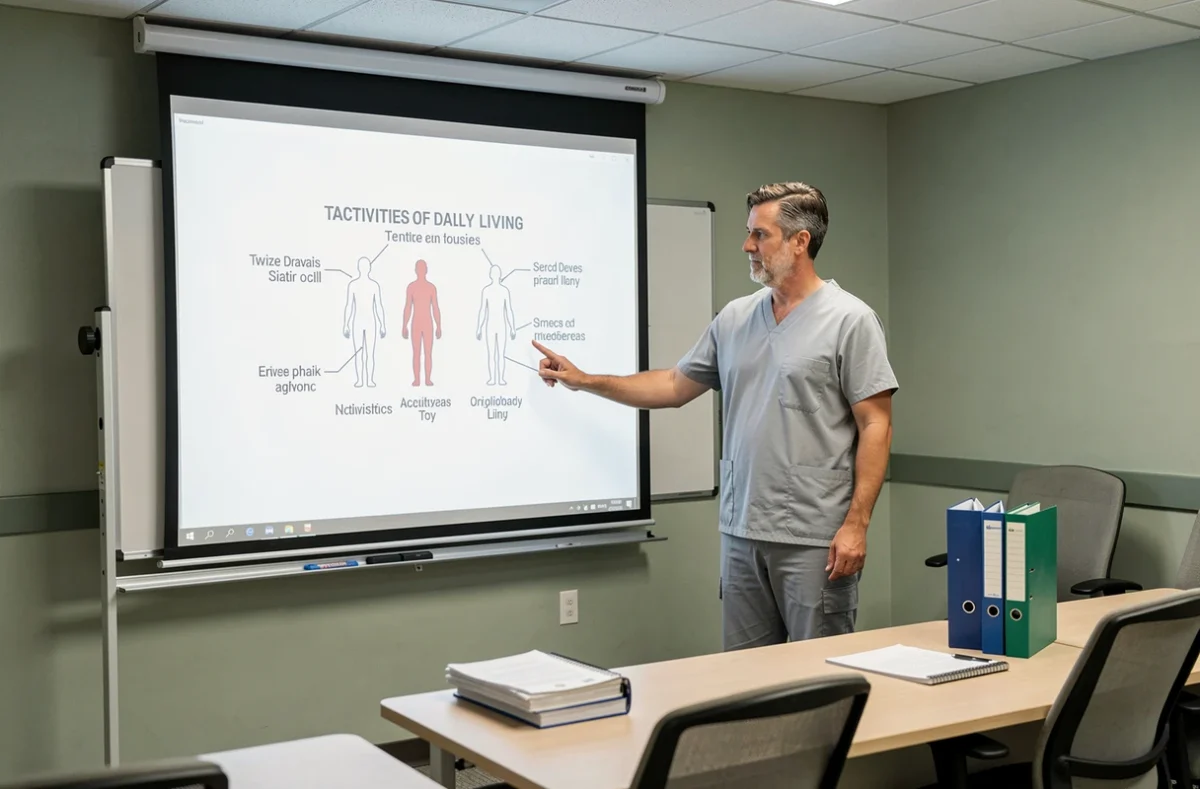
The twelve activities of living in the Roper-Logan-Tierney model
The model is based on a list of twelve activities that everyone performs, with varying degrees of independence, throughout their life. Each activity is assessed along a continuum from complete independence to complete dependence.
- Maintaining a safe environment, breathing, communicating, eating and drinking: these activities relate to vital functions and basic interactions with others.
- Eliminating, washing and dressing, controlling body temperature, mobilizing: these relate to everyday physical independence and are often the first activities assessed on a care ward.
- Working and playing, expressing sexuality, sleeping, dying: these activities are less visible in a care record, but they shape the patient’s quality of life and relationship with care.
The Roper diagram is the visual tool associated with this model. For each activity, the caregiver places a point on a scale from zero (complete dependence) to four (complete independence), then connects the points. The resulting shape provides a snapshot of the patient’s situation.
Why the Roper diagram should not remain static
A common pitfall is to complete the diagram once, on admission, and never revisit it. Turhal et al.’s study highlights how relational and emotional barriers can distort the initial assessment, particularly for sensitive activities. The assessment should be revisited over time and adapted to the person’s readiness.
In practice, this means completing the diagram again on different dates, using a different color for each assessment. This longitudinal follow-up makes progress or deterioration visible and allows the care plan to be adjusted accordingly.
The Roper model and the regulatory framework for nursing care in France
Using a theoretical model does not remove the need to understand the legal framework. The nursing competency framework published on Légifrance links clinical reasoning, assessment of independence, and routine care in daily life. The Roper model structures observation, but does not replace the regulatory framework.
Have you noticed that the same patient can be assessed differently depending on the tool used? That is normal. The Roper model is a framework for thinking, not a medical protocol. It directs the caregiver’s attention to dimensions that other assessment tools overlook (sexuality, attitudes toward death), but it does not define authorized procedures or the limits of professional competence.
This distinction is particularly important in nursing education. Students learning to use the diagram need to understand that it helps organize data collection and identify care priorities, not make a medical diagnosis.
Practical application in nursing homes and community care
In nursing homes, the Roper diagram helps track changes in residents’ independence over several months. The activities “mobilizing” or “eating and drinking” can change rapidly after a fall or an infection. Comparing two diagrams a few weeks apart makes these changes visible to the entire care team.
In community care, the model serves more as a mental guide. A nurse visiting a patient at home may not always have time to complete a full diagram, but can structure their observations around the twelve activities to make sure nothing is overlooked. Each visit becomes a partial reassessment rather than a simple technical procedure.
Practical limitations of the Roper model in nursing
The model was developed in the United Kingdom in the 1970s. Nursing practice has evolved since then, and some criticisms deserve consideration.
The first concerns categorization. Dividing a person’s life into twelve distinct activities creates the appearance of comprehensiveness. But some situations do not fit neatly into a single category. Chronic pain, for example, affects sleep, mobility, communication, and mood at the same time. The model works best as a starting point rather than a rigid framework.
The second limitation concerns the sensitive activities already mentioned. Without specific training in conversations about sexuality or end of life, caregivers may either avoid these topics or address them awkwardly. The framework does not provide the interpersonal skills needed to gather this information.
Despite these limitations, the Roper-Logan-Tierney model remains a valuable teaching tool. It teaches nursing students to consider the person as a whole, beyond the reason for hospitalization. A holistic approach is not an abstract ideal; it is a structured method of observation. Used judiciously and reassessed regularly, the Roper diagram remains highly relevant to everyday practice.