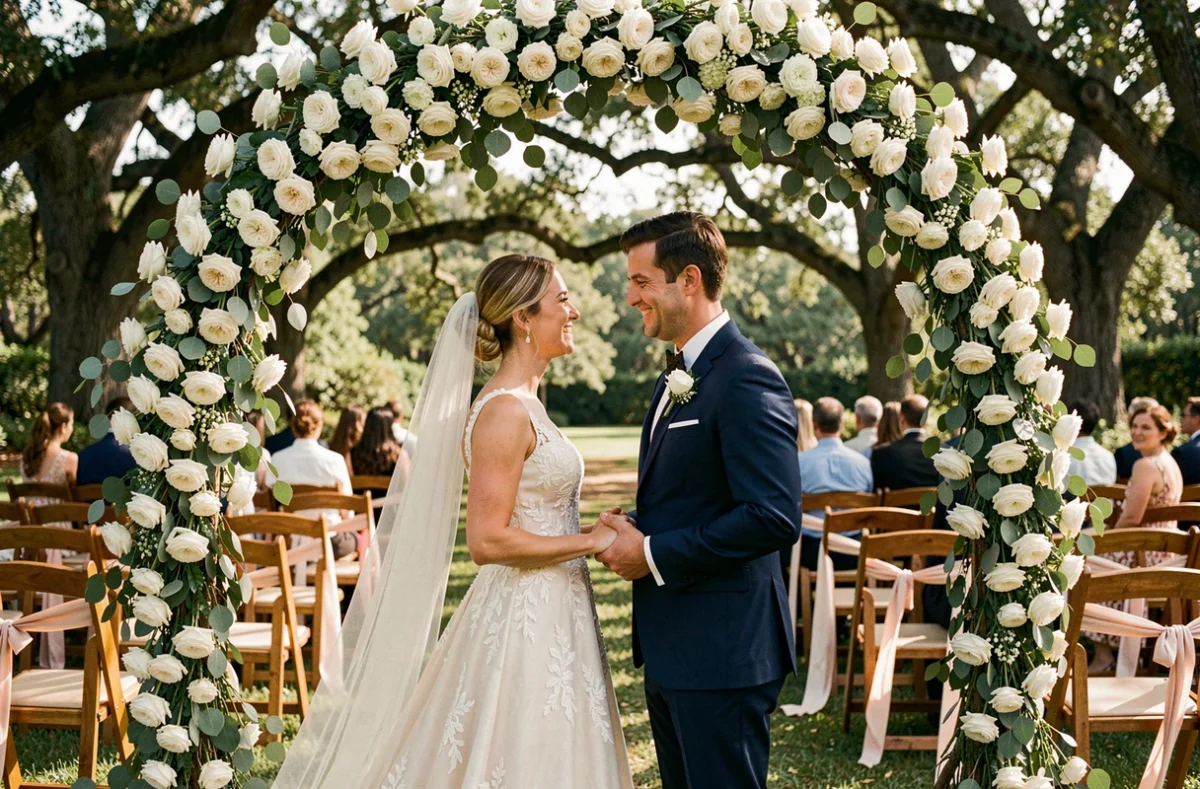
Organizing a wedding involves dozens of decisions that unfold over several months. Budget, venue, service providers, administrative procedures: each item influences the next, and a delay in one often shifts the entire timeline. The following seven points isolate the concrete choices to be made, in an order that allows you to secure each step before moving on to the next.
1. Define the budget and priorities
The budget dictates almost all choices. Before consulting any service providers, list your sources of funding (savings, potential family contributions) and set a total budget.
Then allocate this budget by item. The three items that typically take up the largest share are usually the reception venue, catering, and photography or videography. Ranking these items by personal priority prevents you from dedicating the bulk of the budget to a secondary area for you.
Set aside a reserve for unforeseen expenses, ranging from one-tenth to one-fifth of the total. This margin absorbs budget overruns or last-minute additions without jeopardizing the overall balance. On joyeuxmariage.fr, you will find tools that facilitate this budget allocation work.
2. Choose the date and reception venue
The date depends on three intersecting parameters: the availability of the desired venue, that of the town hall, and the calendar constraints of your loved ones. Booking the venue at least twelve months in advance remains the norm for the most sought-after sites.
A wedding on a weekday or outside the summer season significantly reduces rental costs, but assumes that the majority of guests can free themselves. Also check the actual capacity of the venue: number of seats, outdoor space for the cocktail reception, and a covered backup plan in case of rain.
The accessibility of the site is not limited to the main entrance. To ensure every guest can participate comfortably, examine the internal movements, restrooms, and the path between parking and the ceremony. The accessibility obligations for public establishments are governed by the law of February 11, 2005.

3. Assemble the preparation team
Delegating does not mean losing control. Identify two or three reliable close friends, assign them a specific scope (transport coordination, stationery management, liaison with the caterer on the day), and centralize the follow-up in a shared document.
A wedding planner operates on a broader spectrum: negotiating quotes, detailed timelines, coordination on the day of the ceremony. Their cost is justified especially when the number of guests exceeds a hundred or when the couple has little time for preparations.
Each contact person must know their exact scope to avoid overlaps or omissions. A simple table with names, tasks, and deadlines is enough to maintain coherence.
4. Manage administrative procedures
A visit to the town hall is mandatory for any marriage recognized by law. The file generally includes identification documents, birth certificates issued within the last three months, proof of residence, and the list of witnesses.
- Submit the file at least two months before the planned date, as some town halls require longer notice.
- For a marriage involving a foreign national, additional documents (certificate of custom, sworn translations) may be required.
- The publication of the banns, displayed for a minimum of ten days, is a legal prerequisite for the celebration.
The rules for customizing the civil ceremony vary from one town hall to another. Music, speeches, or sound equipment are not necessarily allowed everywhere: ask the civil registry service before preparing anything.
5. Book key service providers
Caterers, photographers, DJs or bands, florists: these providers are often booked a year in advance for high season dates. Request at least three quotes per category to compare services at an equivalent budget.
Read each contract in detail. Check the cancellation clauses, payment conditions (deposit, balance), and any additional charges for overtime. A service provider contract without a clear cancellation clause exposes the couple to real financial risk.
Do not confuse cancellation insurance with weather coverage. For an outdoor wedding, check if rain, wind, or extreme heat are explicitly covered, what thresholds trigger compensation, and which weather station is referenced.
6. Plan the decoration and ambiance
The decoration reflects the couple’s personality. Instead of multiplying elements, focus on three coherent visual components: color palette, floral style, and lighting.
- Seasonal flowers are cheaper and last longer than varieties imported out of season.
- String lights or candles create a warm atmosphere in the evening, at a moderate cost.
- Stationery (menu, place cards, seating plan) benefits from following the same graphic code as the invitation.
Visual coherence among the various elements matters more than their quantity. A simple theme executed with rigor creates a more striking effect than an accumulation of disparate accessories.
7. Anticipate unforeseen events and create emotion
A backup plan in case of bad weather, an emergency kit (sewing, pain relievers, phone charger), a detailed schedule distributed to the service providers: these three measures absorb most common contingencies.
Emotion often arises from personal details, not grand productions. A letter read aloud, a piece of music linked to a shared memory, or a sincere speech from a loved one leave a more lasting impression than standardized entertainment.
The coordination on the day determines the smoothness of the entire day. Designate a single person, either a wedding planner or a trusted friend, who holds the complete schedule and serves as the central contact for each service provider. The couple should never have to manage a logistical issue on the day of their ceremony.